
Spa Facial vs. Medical-Grade Facial: What Is Actually Different
You have been getting facials for years. You enjoy them. You always leave feeling relaxed and a little glowy. But if someone asked whether your skin looks meaningfully different than it did two years ago, you would probably pause before answering.
That pause is worth paying attention to.
There is a real, significant difference between a spa facial and a medical-grade facial. Not in terms of how luxurious the experience feels, but in terms of what is actually happening to your skin during the treatment and whether anything is changing at a biological level. For patients who have been frustrated by results that feel good in the moment but never quite last, understanding this difference is often the turning point.
The Spa Facial: What It Is and What It Is Designed to Do
A spa facial is a wellness-oriented skin treatment offered at day spas, resort spas, and salons. The primary goals are relaxation, temporary hydration, and a short-term brightening effect. Most spa facials follow a similar structure: cleanse, exfoliate with mild scrubs or enzyme products, steam, apply a mask, and moisturize. The products used are cosmetic-grade, meaning they are formulated to work on the outermost surface of the skin without penetrating into the deeper layers where collagen, pigmentation, and cellular activity actually occur.
There is genuine value in a spa facial for the right person and the right purpose. They are relaxing. They temporarily improve surface hydration and glow. For someone with healthy, stable skin who wants a pampering hour before a vacation or a low-key seasonal reset, a spa facial is a perfectly reasonable experience.
The frustration comes when the expectations do not match what the treatment can actually deliver. Cosmetic-grade products cannot stimulate collagen. They cannot meaningfully improve pigmentation, melasma, or sun damage. They cannot treat acne at the source, reduce texture or fine lines over time, or address the chronic inflammation and barrier dysfunction that drive so many visible skin changes. The ingredients are formulated specifically to stay on the surface. That is not a flaw. It is just the reality of how these products are designed and regulated. The problem is when someone with real skin concerns invests time and money in a treatment that was never built to address them.
What Makes a Facial Medical-Grade
A medical-grade facial is a clinical skin treatment performed in a medical aesthetic practice. It is designed to produce measurable, lasting improvement in how your skin looks, feels, and functions, not just a temporary glow you can see on the drive home. The differences begin with the products and extend through the technology used, the clinical credentials of the provider, and whether there is an actual treatment plan guiding what is being done.
The Products Reach a Different Depth
The most fundamental distinction between spa and medical-grade skincare is where the ingredients work. Medical-grade products are formulated at higher concentrations with delivery systems designed to penetrate below the outermost skin layer, into the epidermis and dermis where collagen, elastin, and melanin-producing cells actually live.
Cosmetic-grade products are legally formulated to stay on the surface. They can hydrate, temporarily soothe, and offer some protection, but they cannot drive cellular change because they cannot reach the cells that need to change. When a medical aesthetician applies clinical-strength retinoids, tyrosinase inhibitors, high-concentration AHAs and BHAs, growth factors, or medical-grade antioxidants, the skin responds differently because the active ingredients actually reach their target tissue. That is a biological reality, and it is the reason patients who switch from spa facials to medical-grade treatments often describe the difference as immediately noticeable.
Exfoliation That Goes Beyond the Surface
Exfoliation at a spa typically means mild mechanical scrubs or low-percentage enzyme products that soften the very top layer of skin. That has value, but it has limits.
Clinical exfoliation goes deeper and more precisely. Dermaplaning, when performed by a trained provider, removes not just surface dead skin but the fine vellus hair and superficial keratin buildup that makes texture visible and causes makeup to sit unevenly. Patients often describe this as one of the most immediately satisfying treatments they have ever had, because the difference in skin surface is something they can feel the moment the treatment is done.
Medical-grade chemical peels like the VI Peel use combinations of TCA, salicylic acid, and retinoic acid at concentrations that penetrate into the epidermis, triggering controlled cell turnover and genuine skin renewal. A spa peel is typically a low-strength glycolic or enzyme treatment with minimal to no actual peeling. The process and the results are not comparable, and most patients who experience both understand that distinction immediately.
Clinical Technology That Changes the Skin
This is where the difference between spa and medical-grade becomes most dramatic. Medical aesthetic practices invest in clinical-grade devices that are not available in spa settings and that produce results topical skincare alone simply cannot replicate.
HydraFacial uses patented vortex technology to simultaneously cleanse, extract, and infuse medical-grade serums into the skin. The infusion step delivers antioxidants, hyaluronic acid, and peptides at a concentration and depth that no topical application can match, and the extraction mechanism removes congestion without the inflammation that manual extraction often causes. It is one of the most consistently loved treatments at CSLC because the results are visible the same day and skin continues to improve in the days that follow.
Radiofrequency treatments like Forma deliver controlled electrical energy into the dermis, heating the tissue to stimulate fibroblast activity and new collagen production. The result is measurable firming along the lower face and jawline, driven by a real biological response that requires precise temperature delivery into living tissue. A spa facial cannot replicate this because it does not use technology that reaches the dermis.
Carbon Laser Peels use a Q-switched laser to vaporize a carbon lotion applied to the skin, clearing debris from deep within pores while simultaneously stimulating collagen. The result is visible pore refinement, improved texture, and a brightness that lasts well beyond what a surface treatment can achieve.
The Provider Makes a Difference You Will Feel
At a day spa, facials are performed by licensed estheticians who are skilled at what they do and trained in skincare and relaxation techniques. What they are not trained in is clinical skin assessment, medical-grade treatment protocols, contraindication management, or the kind of skin analysis that guides a treatment plan for changing or compromised skin.
At a medical aesthetic practice like CSLC, your provider may be a medical aesthetician trained in clinical-grade protocols and chemical peel management, or a nurse practitioner or PA-C who evaluates your skin from a medical standpoint. This changes the nature of the visit entirely. Your treatment is evaluated before it is performed. A clinical provider assesses barrier function, hydration levels, pigment distribution, collagen status, pore behavior, and inflammation pattern before recommending anything. They recognize when aggressive exfoliation would aggravate a compromised barrier. They understand that a patient on certain medications needs a modified peel protocol. They know what your skin is doing and why, and that knowledge is built into every recommendation.
The most important part of a clinical skin visit is often the conversation. Why is your skin suddenly so dry? Why is your makeup sitting differently than it did two years ago? Why are pores, redness, brown spots, or crepiness harder to address than they used to be? Those questions have real answers. And the right provider will help you find them.
Ready to find out what your skin actually needs? Book a complimentary skin consultation at any CSLC location.
A Treatment Plan, Not a One-Time Visit
Perhaps the most meaningful long-term difference between a spa facial and a medical-grade facial program is whether there is a plan behind what is being done.
A spa facial is typically a standalone experience. You book it, enjoy it, and leave. There is no ongoing skin assessment, no treatment sequencing, and no coordination between visits or between products and in-office treatments.
A medical aesthetic practice evaluates your skin as a system. Your provider considers what your skin is doing now, why it is doing it, and what treatment sequence makes the most sense for your specific concerns and goals. Your HydraFacial might be scheduled between a VI Peel series to maintain results during a corrective phase. Your Forma RF might be timed alongside a collagen-building medical-grade skincare protocol to amplify the firming response. Your event skin is planned with your skin’s actual response time in mind, not just your calendar.
Healthy skin is the foundation of every great aesthetic result. And healthy skin rarely happens by accident. It happens with the right treatment at the right time, guided by a provider who understands where your skin is now and where you want it to go.
Spa vs. Medical-Grade Facial: Side by Side
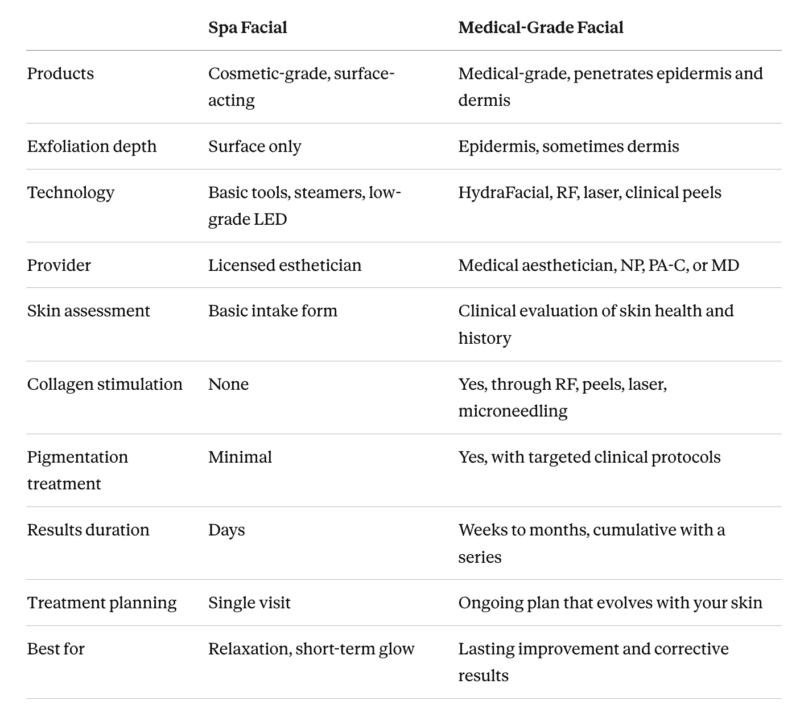
Ready to see what a medical-grade facial looks like in practice? Explore our full facial menu at CSLC.
How to Know Which One Your Skin Actually Needs
If your primary goal is relaxation and your skin is healthy and stable, a spa facial is a completely reasonable choice. There is nothing wrong with it for that purpose.
But if your skin has changed and you cannot quite figure out why, that is worth taking seriously. Skin changes because collagen declines, cell turnover slows, barrier function weakens, hormones shift, sun damage accumulates, and the repair processes that once kept skin looking consistent begin to slow down. When the products and routines that once worked stop working, it is usually because the underlying cause of the change has not been addressed, and a surface-level treatment cannot reach it.
If you have been getting regular facials but you are not seeing improvement, that is a signal. A facial that makes your skin feel good for a few days but produces no lasting change is not operating at the level your skin needs. If you are dealing with pigmentation, acne, texture, crepiness, fine lines, or makeup that no longer sits the way it used to, those concerns require clinical-grade ingredients, clinical technology, and a real treatment plan. And if you want results that compound over time rather than reset at every appointment, a series of medical-grade treatments is where that kind of cumulative improvement actually comes from.
What to Look for in a Medical Aesthetic Practice
Not every practice that uses the words “clinical” or “medical-grade” operates at the same standard. When you are evaluating a medspa or aesthetic clinic, there are a few things worth looking for.
Credentialed providers with documented clinical training matter. Physician medical director oversight matters. Actual medical-grade product lines, not rebranded cosmetic products with clinical-sounding names, matter. And perhaps most importantly, a consultation process that is honest about what your skin needs rather than simply confirming what you came in hoping to hear matters. A good clinical provider tells you what your skin actually needs. They are realistic about outcomes. They build a plan that makes sense for your skin as it is today and where you want it to go over the next year.
At CSLC, we have been doing this work since 2001. Our team includes medical aestheticians, nurse practitioners, physician assistants, and physicians across more than 20 locations in Michigan, Florida, and South Carolina. Every skin treatment begins with an honest clinical assessment, because great skin starts with understanding what your skin actually needs, not just what sounds appealing.
Not sure where to start? Book a complimentary consultation and let our team evaluate your skin and build a plan around your goals.
The Real Difference, in Plain Terms
A spa facial is a relaxing, enjoyable experience with real short-term benefits on the skin’s surface. A medical-grade facial is a clinical treatment designed to produce measurable, lasting improvement in how your skin looks, feels, and functions over time.
If you want to relax, a spa is a wonderful choice. If you want your skin to actually change, to look smoother, brighter, calmer, and healthier because it is being treated at the right depth with the right tools by the right provider, a medical aesthetic practice is where that happens.
Clinical-grade ingredients penetrate deeper. Clinical technology creates real cellular change. Clinical providers have the training to assess your skin, plan your treatment, and adjust your approach as your skin evolves. That is the difference between a treatment that feels good for a week and a treatment plan that changes what your skin looks like a year from now.
If your skin has been telling you it needs something more, it probably does.
Start with skin. See real change.
Frequently Asked Questions About Spa vs. Medical-Grade Facials
What is the main difference between a spa facial and a medical-grade facial?
The main difference is depth and clinical intention. A spa facial uses cosmetic-grade products that work on the skin’s surface to deliver relaxation and short-term hydration. A medical-grade facial uses higher-concentration ingredients and clinical technology that penetrate into the epidermis and dermis, producing measurable changes in collagen, pigmentation, texture, and skin health over time. The provider’s clinical training and the presence of a treatment plan also distinguish the two significantly.
Are medical-grade facials better than spa facials?
They serve different purposes. If your goal is relaxation and your skin is healthy, a spa facial is a perfectly good experience. If your goal is visible, lasting improvement in tone, texture, pigment, hydration, collagen, or skin quality, a medical-grade facial is the more effective choice because it operates at a clinical level that cosmetic-grade treatments cannot match.
How long do the results of a medical-grade facial last?
Results vary by treatment. A HydraFacial typically produces visible improvement for one to two weeks, with cumulative improvement when done on a regular schedule. Treatments like VI Peel, Carbon Laser Peel, and Forma RF produce longer-lasting results because they trigger biological changes in the skin, including collagen stimulation and accelerated cell turnover, that continue to develop in the weeks after treatment.
Can a spa facial improve pigmentation or brown spots?
Not meaningfully. Addressing pigmentation, melasma, or sun damage requires ingredients and technology that penetrate below the skin’s surface to affect melanin-producing cells. Treatments like the VI Peel, Carbon Laser Peel, and Foundation Trio, combined with appropriate medical-grade skincare, are designed for that level of correction.
Who performs medical-grade facials?
At a qualified medical aesthetic practice, medical-grade facials are performed by medical aestheticians, registered nurses, nurse practitioners, or physician assistants, depending on the treatment. Provider credentials and clinical training matter significantly. Always ask who will be performing your treatment and what their clinical background is.
How often should you get a medical-grade facial?
It depends on your treatment and goals. Maintenance treatments like HydraFacial and Signature Facial are often scheduled every four to six weeks. Corrective treatments like chemical peels may be done in a series with recovery time between sessions. Your provider will recommend a schedule based on your specific skin concerns and the treatment plan they design for you.
What is the best medical-grade facial for first-time patients?
For most first-time patients, a Signature Facial or HydraFacial is a strong starting point. Both are customizable, have no downtime, and allow your provider to assess your skin in a clinical setting before recommending a longer-term plan. Our facials page walks through every option we offer so you can get a sense of what might be right for you. The best first treatment is always the one recommended after a real consultation, not a one-size-fits-all default.
📍 Cosmetic Skin & Laser Center (CSLC) has locations nationally. You can find facials at CSLC in:
- Northern Michigan: Petoskey, Harbor Springs, Traverse City, Suttons Bay
- Southeast Michigan: Bloomfield Hills, Ann Arbor, East Lansing, Fenton, Chelsea
- West Michigan: East Grand Rapids
- Southwest Florida: Naples, North Naples, Marco Island, Boca Grande, Sarasota
- Southeast Florida: Palm Beach, Hobe Sound, Vero Beach, Wellington
- Greater Orlando: Winter Park, Lake Mary
At Cosmetic Skin and Laser Center, facials are part of a clinical skin strategy, not a one-size-fits-all menu. We look at your skin through a clinical lens, evaluate what it is doing and why, and build a plan that helps it look smoother, brighter, calmer, and healthier over time. Whether your starting point is a HydraFacial, dermaplaning, a VI Peel, Forma RF, or Foundation Trio, we help you find the right treatment for your skin now and the right strategy for where you want it to go. With locations across Michigan, Florida, and South Carolina, great skin is closer than you think. Book a complimentary skin consultation and start there.